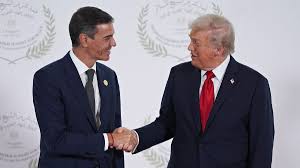
Diplomacy often lives in the space between caution and courage. But every once in a while, a leader decides to step out of that space—and make a stand.
That’s exactly what happened when, in a meeting meant to project unity,
Donald Trump abruptly threatened to “kick Spain out of NATO” unless Madrid raised its defense spending to 5 percent of GDP. It was an astonishing statement—one that instantly echoed through European capitals and across Washington’s corridors of power.
The remark came during Trump’s joint press conference with Finnish President Alexander Stubb—a setting meant to highlight cooperation, not confrontation. Cameras caught the moment the former president leaned toward reporters and said it bluntly:
“If Spain refuses to raise its defense spending to 5 percent of GDP, then get out of NATO.”
The audience froze. Analysts described it as “a diplomatic grenade tossed into a crowded room.”
But less than 24 hours later, Spanish Prime Minister Pedro Sánchez would deliver three calm, devastating moves that flipped the entire story—and turned Trump into the butt of late-night jokes from Madrid to Washington.
1. “Spain’s Defense Budget Is Spain’s Decision.”
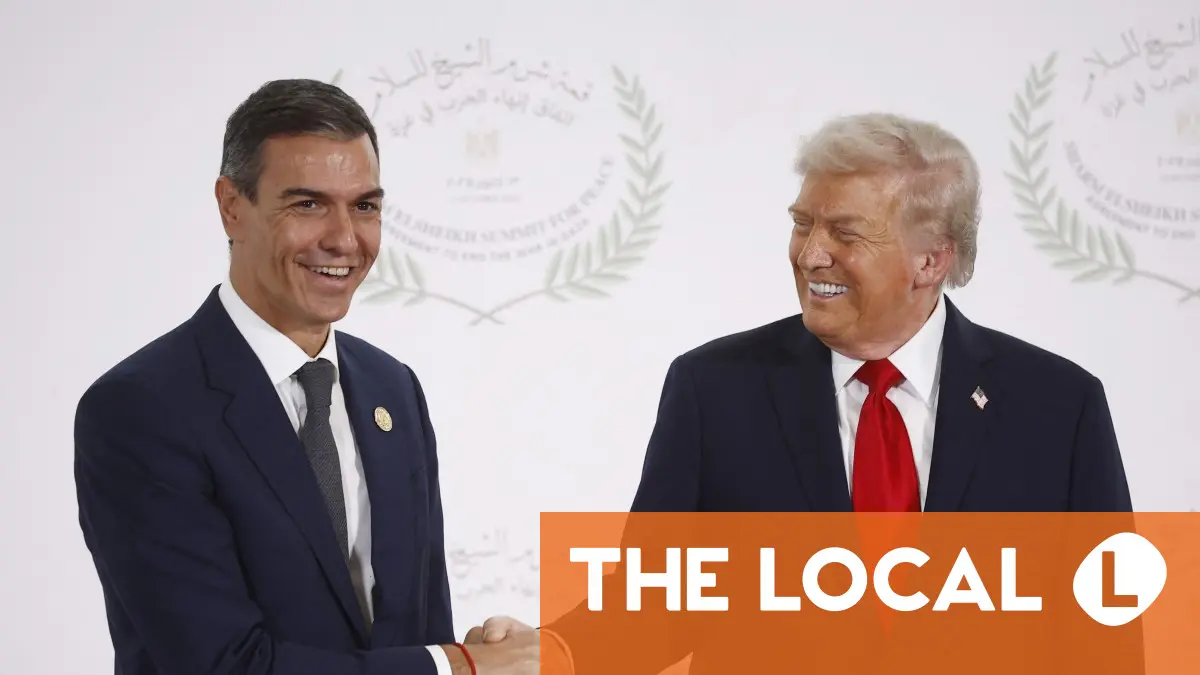
Within hours of Trump’s remark, Sánchez convened a brief press conference at La Moncloa Palace. There were no theatrics, no raised voice—just a measured, unmistakable firmness.
“Spain’s defense budget,” he said slowly, “is decided by Spain alone. No one can order us. Not even those who believe the world still moves by threat.”
It was the kind of defiant clarity Europe hadn’t heard since de Gaulle’s era—a quiet thunder that reverberated across the Atlantic.
The Spanish public applauded. NATO diplomats, privately relieved, admitted Sánchez had said what many dared not: that alliance membership is built on respect, not intimidation.
2. “Tariffs Are Not Yours to Command.”
Trump’s statement wasn’t just about defense—it was also a veiled threat of economic retaliation. But Sánchez, a former economist with years of European experience, dismantled that threat with one reminder:
“Tariffs are controlled by the European Commission,” he said, “not by any single member or external demand. If someone wants unilateral sanctions—impossible.”
It was a masterclass in poise and precision. In one sentence, Sánchez not only defused Trump’s leverage but exposed a misunderstanding of basic EU law.
European analysts called it “a public schooling in diplomacy.” American pundits, meanwhile, noted the symbolism: Europe standing united while the U.S. looked erratic and divided.
3. “Meet Your Own Standards First.”

By nightfall, Sánchez had delivered his third and most cutting move. During a live interview with El País, he addressed Trump directly:
“You demand others raise defense spending,” Sánchez said, “yet never meet your own standards of consistency or respect.”
It was an elegant strike—personal but dignified. Within minutes, the quote went viral. Spanish news anchors replayed it in slow motion; commentators called it “the line heard around NATO.”
Across Europe, leaders privately thanked Sánchez for saying what many had whispered behind closed doors.
A World Watching the Tables Turn
For older Americans who remember Reagan in Berlin or Bush in Brussels, this episode felt like watching history in reverse: an American leader using threats, and a European leader answering with calm authority.
In Madrid, late-night shows opened with mock “NATO eviction notices,” while London newspapers ran headlines like “Spain Schools Trump on Global Respect.” Even former U.S. diplomats admitted that the episode left the former president looking “isolated and impulsive.”
The message was unmistakable: alliances aren’t built on ultimatums—they’re built on mutual respect.